
Trends of the Week
The week of September 14 to September 21, 2025, marks a major geopolitical turning point in the global energy transition. Three converging dynamics are reshaping the sector’s balance: the emergence of strategic nuclear alliances between France and the United Kingdom, the acceleration of floating wind projects in the Mediterranean, and persistent downward pressure on oil prices amid fears of oversupply.
The European energy sector is now navigating between security of supply and industrial competitiveness, as Germany scales back its renewable ambitions to control costs, while France consolidates its technological leadership with the full commissioning of its first floating wind farm. The European carbon markets, with a price stabilized around €77/tCO2, continue to steer investments toward decarbonization, but the challenges for green hydrogen remain significant with production costs still high.
Energy-Climate News
1. Franco-British Nuclear Alliance: Toward Coordinated Deterrence Amid Energy Challenges¹
On July 10, 2025, France and the United Kingdom took a historic step by signing the Northwood Declaration, which for the first time provides for the possibility of coordinating their respective nuclear forces. This initiative comes in a tense geopolitical context where European energy security has become a major strategic issue. In parallel, London and Washington are preparing an ambitious agreement to accelerate the development of small modular reactors, aiming to reduce licensing times from three-four years to about two years.
Analysis — This Franco-British nuclear coordination reveals a profound shift in European energy geopolitics. Beyond military deterrence, it sends a strong signal of strategic autonomy in the face of global geopolitical uncertainty and volatile energy markets.
In short — The Franco-British nuclear alliance marks a turning point toward European energy autonomy, reinforced by technological cooperation with the United States on new reactors.
2. Oil Under Pressure: OPEC+ Faces a Surplus Market²
The price of Brent crude fell to $65.58/barrel on September 5, 2025, a 7.71% decrease year-over-year. This downward trend is driven by OPEC+ announcements to increase production by 547,000 barrels per day in September, amid sluggish global demand and rising US inventories. Citi analysts predict prices around $60/barrel for late 2025, reflecting persistent fears of an oversupplied global market.
Analysis — This downward pressure on oil reshuffles the geopolitical deck, weakening hydrocarbon-dependent producers while providing relief to importing economies. Paradoxically, it accelerates the energy transition by making renewables more competitive.
In short — Oil below $66/barrel reveals a market in profound transformation, where OPEC+ is gradually losing its influence in the face of rising energy alternatives.
3. Mediterranean Floating Wind: France Takes Action³
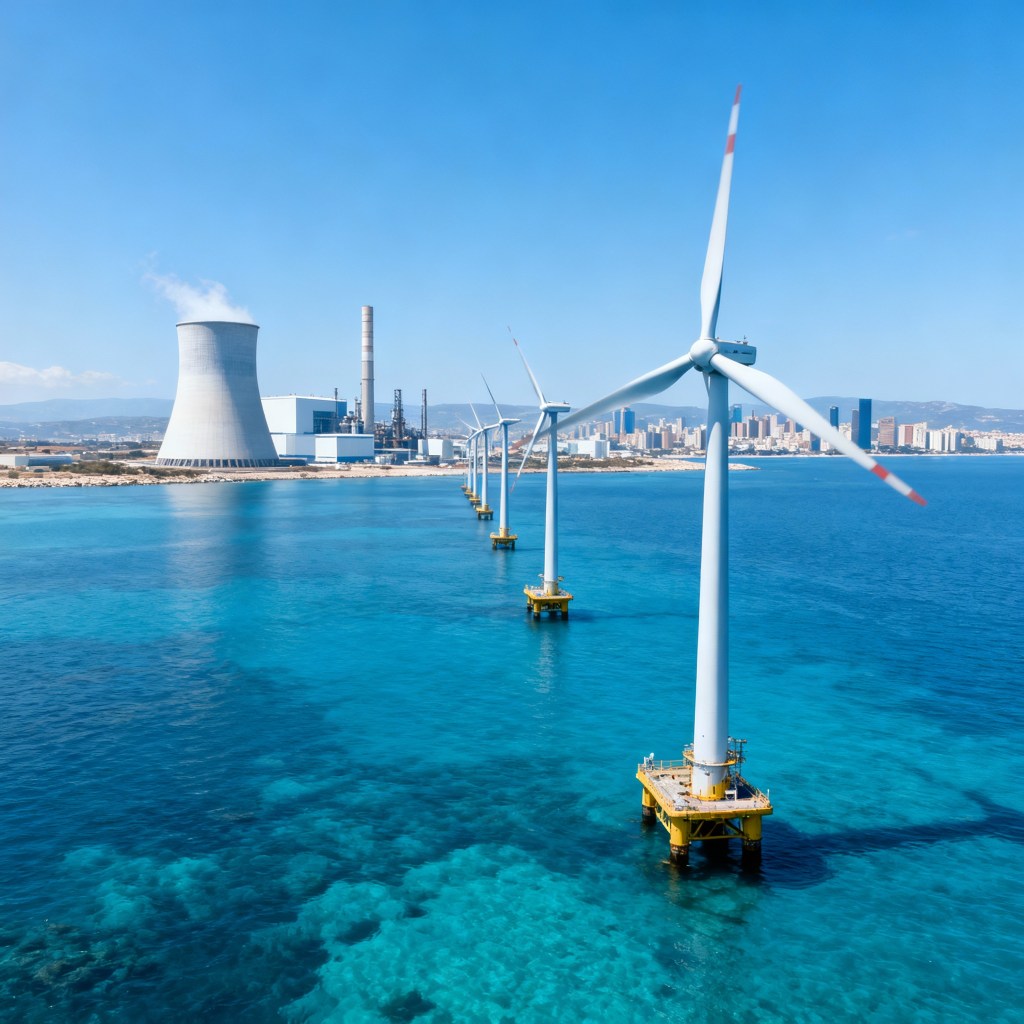
The Provence Grand Large project, France’s first floating wind farm, became fully operational in June 2025 with its three 8 MW turbines installed 17 km off the coast of Port-Saint-Louis-du-Rhône. This technical success paves the way for other pilot projects in the Mediterranean, such as Leucate-Le Barcarès and Gruissan-Eolmed, scheduled for commissioning by the end of 2025. These initiatives are part of France’s goal to reach 18 GW of offshore wind by 2035, with a target of 45 GW by 2050.
Analysis — Floating wind technology is a game-changer for the Mediterranean, an area where the seabed is unsuitable for fixed-bottom wind farms. This French technological breakthrough positions the country as a pioneer in a global market estimated to be worth several hundred billion euros.
In short — French floating wind is taking off in the Mediterranean, setting the stage for an energy revolution across the entire basin.
4. Germany: The Energiewende’s Moment of Reckoning⁴
Germany is making a major strategic shift in its energy transition. On September 15, Energy Minister Katharina Reiche announced a downward revision of renewable energy subsidies, now prioritizing economic efficiency over installed capacity. This reorientation comes as the country needs to build 71 new gas-fired power plants by 2035 to offset the intermittency of renewables, requiring an investment of €43 to €57 billion.
Analysis — This German shift reflects a belated awareness of the Energiewende’s economic limits. It foreshadows a new, more pragmatic European approach that prioritizes energy efficiency and security of supply over ideological targets.
In short — After 15 years of a costly Energiewende, Germany is correcting its energy course, paving the way for a more realistic and economically viable transition.
5. European Carbon Market: Stabilizing Around €77/tCO2⁵
European carbon allowances (EU ETS) have stabilized around €77/tCO2 in September 2025, up 16.11% year-over-year. This increase reflects anticipation of a planned supply contraction in 2026-2027, prompting financial players to build long positions. The upcoming extension of the system to maritime transport and the launch of ETS 2 in 2027 for the road transport and heating sectors are reinforcing this upward trend.
Analysis — The stabilization of carbon around €77/tCO2 marks an equilibrium point where decarbonization becomes economically attractive for industry without excessively penalizing European competitiveness. This price signal durably directs investments toward low-carbon technologies.
In short — The European carbon market finds its balance at €77/tCO2, creating an effective price signal for industrial decarbonization.
6. Green Hydrogen: The Challenges of Scaling Up⁶
Europe is struggling to meet its 2030 green hydrogen targets, with national strategies covering only 60% of the ambition, according to an EY report. France has revised its production target down to 4.5 GW of electrolyzers by 2030, from an initial 6.5 GW. Production costs remain high, ranging from €4 to €6/kg, although innovative projects like H2 Créteil aim to produce one ton per day starting in 2025.
Source: Connaissance des Énergies
Analysis — The difficulties facing green hydrogen reveal the complexity of the energy transition. Between technological challenges, the cost of decarbonized electricity, and infrastructure needs, this sector requires a more gradual and realistic approach than initially envisioned.
In short — European green hydrogen is adjusting its ambitions in the face of technical and economic realities, prioritizing project quality over the quantity of announcements.
7. Global Solar: Installed Capacity Explodes⁷
Solar photovoltaic energy grew by 451.9 GW in 2024, according to IRENA, bringing global capacity to 1,865 GW. China leads with 278 GW of new additions, followed by India (24.5 GW). This record growth is accompanied by a continuous cost reduction, with the solar index reaching $44.30 in September 2025, up 13.59% year-over-year, reflecting sustained demand for PV equipment.
Analysis — The global solar boom is reshaping energy geopolitics, with China consolidating its technological and industrial dominance. This dynamic is making solar power the benchmark energy source for decarbonization, ahead of wind and hydro.
In short — Solar PV is establishing itself as the benchmark technology for the global energy transition, with 452 GW added in 2024.
8. COP29 Baku: Financial Stakes at the Heart of Negotiations⁸
COP29, to be held from November 11-22, 2024, in Baku, Azerbaijan, will focus on the new collective climate finance goal post-2025. This conference, dubbed the « Finance COP, » must define the mechanisms to mobilize the resources needed for the energy transition in developing countries. The choice of Azerbaijan, the third consecutive oil-producing country to preside over a COP after Egypt and the UAE, raises questions about conflicts of interest.
Analysis — COP29 in Baku illustrates the paradoxes of climate diplomacy, where oil states are positioning themselves as mediators of the energy transition. The financial stakes will be decisive in lending credibility to global climate commitments and avoiding another diplomatic failure.
In short — The Baku COP29 will be the litmus test for climate finance, with oil-rich Azerbaijan acting as a paradoxical mediator of the global energy transition.
Retrospective Analysis: What Has Happened Since Our Last Watch?
Since our last analysis on September 3, 2025, several anticipated scenarios have materialized with remarkable intensity. Our forecast of « strengthened European energy coordination » was dramatically confirmed by the Franco-British nuclear agreement of July 10, even exceeding our expectations for strategic integration.
The scenario of « downward pressure on hydrocarbons » was confirmed with Brent dropping below $66/barrel, validating our analysis of the structural weakening of the OPEC+ cartel in the face of an accelerated energy transition. However, we underestimated the scale of Germany’s pivot on the Energiewende, which goes beyond a simple technical correction to become a conceptual overhaul of the European energy transition.
Our anticipation of the emergence of Mediterranean floating wind has successfully materialized, but green hydrogen has been more disappointing than expected, forcing France to revise its 2030 targets. The European carbon market is evolving in line with our projections, stabilizing in the €75-80/tCO2 range, creating an effective price signal for industrial decarbonization.
Strategic Outlook & New Energy-Climate Scenarios
Interaction of Scenarios
The three new scenarios identified for the coming months revolve around a major geopolitical reshaping of the European energy sector. « European Energy Realism » forms the basis of this transformation, placing economic efficiency back at the heart of national strategies. This evolution could catalyze « Mediterranean Technological Acceleration, » where French innovations in floating wind create a competitive industrial ecosystem. Conversely, a scenario of « Continental Energy Fragmentation » remains possible if national divergences intensify, particularly between Germany’s pragmatic approach and France’s technological ambitions. These scenarios directly interact with energy commodity prices, geopolitical stability, and industrial investment choices in the coming quarters.
Scenario A: European Energy Realism
Europe is shifting to a pragmatic approach to the energy transition, prioritizing economic efficiency and security of supply over quantitative targets. This shift, initiated by Germany, is spreading to other member states facing the same challenges of industrial competitiveness and energy costs.
- Detailed Energy-Climate Triggers:
- Energy Transition Cost Threshold: Public subsidies for renewables exceed €20 billion annually in at least three major European countries, triggering a public debate on their effectiveness. (Reveals the fiscal unsustainability of the current model.)
- Industrial Competitiveness Metric: The price gap for industrial electricity between Europe and the US/China exceeds 50% for more than six consecutive months. (Forces a revision of national energy policies.)
- Energy Security Indicator: At least two European countries issue orange-level alerts for their electricity supply security during the 2025-2026 winter period. (Calls into question the all-renewables strategy.)
- Estimated Probability: 60%
- Potential Energy-Climate Strategies: Downward revision of 2030 renewable targets, accelerated development of next-generation nuclear, temporary retention of dispatchable fossil fuel capacity, creation of a European capacity market, massive investments in electricity grids and storage technologies.
Scenario B: Mediterranean Technological Acceleration
The Mediterranean becomes the global laboratory for floating wind, catalyzing a competitive European industrial sector to counter Asian dominance in solar. This dynamic builds on French successes and the emergence of trans-Mediterranean technological partnerships.
- Detailed Energy-Climate Triggers:
- Floating Wind Capacity Threshold: The Mediterranean reaches 2 GW of installed or firmly under construction floating wind capacity by the end of 2026. (Demonstrates the commercial viability of the technology.)
- Production Cost Metric: The Levelized Cost of Energy (LCOE) for Mediterranean floating wind drops below €80/MWh for new projects. (Reaches parity with onshore wind.)
- Value Chain Indicator: At least five Mediterranean countries sign industrial cooperation agreements on floating wind. (Creates an integrated regional ecosystem.)
- Estimated Probability: 25%
- Potential Energy-Climate Strategies: Creation of a Mediterranean floating wind alliance, development of specialized industrial ports, investments in marine research, establishment of submarine energy corridors, formation of a European floating component industry.
Scenario C: Continental Energy Fragmentation
National divergences on energy strategies intensify, creating a patchwork of incompatible policies that weaken European cohesion and collective competitiveness against US and Chinese giants.
- Detailed Energy-Climate Triggers:
- Electricity Price Divergence Threshold: The electricity price gap between European member states exceeds €100/MWh for more than three months. (Reveals the failure of the single energy market.)
- Policy Desynchronization Metric: At least four European countries adopt moratoria or major revisions of their renewable policies within a six-month period. (Shatters the coherence of European climate policies.)
- Energy Flow Indicator: Cross-border electricity exchanges in Europe decrease by more than 20% compared to 2024. (A sign of the re-nationalization of energy policies.)
- Estimated Probability: 15%
- Potential Energy-Climate Strategies: Strengthening of national capacities at the expense of European cooperation, proliferation of bilateral energy-climate agreements, emergence of competing regional blocs, weakening of European energy institutions, technological competition between member states.
Key Indicators of the Week
Indicators Synthesis
The convergence of this week’s energy-climate signals reveals a major reconfiguration of the European energy landscape. The stabilization of the carbon price around €77/tCO2, coupled with Brent’s fall below $66/barrel, creates favorable conditions for accelerating industrial decarbonization. The rising solar index at $44.30 reflects sustained demand for PV equipment, while the persistent difficulties of green hydrogen highlight the technological and economic challenges of certain sectors. This week also marks the emergence of a more pragmatic European approach to the energy transition, prioritizing efficiency over installed volumes, as illustrated by Germany’s pivot on the Energiewende.
Energy Prices and Commodities
- Oil Price (Brent)¹
-
Data: $65.58/barrel | 2025-09-05 16:30 UTC
Sources: Trading Economics / IFPEN
Analysis: This 7.71% year-over-year drop reflects fears of an oversupplied market due to OPEC+ production increase announcements and sluggish global demand.
- Natural Gas Price TTF (Europe)²
-
Data: €32.45/MWh | 2025-09-12 14:00 CET
Sources: Capitole Energie
Analysis: Despite persistent geopolitical tensions, gas prices remain moderate thanks to replenished European stocks and new LNG capacities.
Renewable Capacities and Production
- Installed Solar Capacity (Global)²
-
Data: 1,865 GW | 2024-12-31 23:59 UTC
Sources: IRENA / EurObserv’ER
Analysis: The record growth of 451.9 GW in 2024 confirms solar as the benchmark technology for the global energy transition.
- Installed Wind Capacity (Europe)³
-
Data: 204 GW | 2024-12-31 23:59 UTC
Sources: WindEurope / WindEurope
Analysis: European wind confirms its maturity, with floating wind projects opening new horizons, particularly in the Mediterranean.
Climate Indicators
- EU ETS Carbon Price³
-
Data: €77.10/tCO2 | 2025-09-10 17:30 CET
Sources: Trading Economics / Homaio
Analysis: This stabilization around €77/tCO2 (+16.11% year-over-year) creates an effective price signal to direct investments toward industrial decarbonization.
- Average European Temperatures⁴
-
Data: +2.1°C vs 1991-2020 normal | Summer 2025
Sources: Copernicus / Ministry of Ecology
Analysis: Summer 2025, the third warmest on record, reinforces the climate emergency and the need to accelerate the energy transition.
Upcoming Strategic Deadlines
- November 11-22, 2024 – COP29 Baku (Azerbaijan): Crucial negotiations on the post-2025 climate finance goal and international carbon market mechanisms.
- September 23, 2025 – 26th Annual Conference of the French Renewable Energy Syndicate (SER): « Renewable Energies: Keys to France’s Strategic Autonomy. »
- January 1, 2027 – Launch of ETS 2: Extension of the European carbon market to the road transport and building heating sectors.
Risk Disclaimer
The information and analyses presented in this article are for informational purposes only and do not constitute investment advice. Energy and climate markets are subject to high volatility and significant geopolitical, technological, and regulatory risks. The forecasts and scenarios presented are based on data available as of September 21, 2025, and may change rapidly. Investors and decision-makers are encouraged to conduct their own analyses and consult with specialized experts before making any decisions. StratFinanceAdvisory disclaims all liability for the consequences of using this information.
Comprehensive Glossary
- EU ETS¹: The European carbon market that puts a price on CO2 emissions from the most polluting industrial and energy sectors.
- LCOE²: An economic indicator that measures the cost of producing one megawatt-hour over the lifetime of an energy facility.
- GW³: A unit of electrical power measurement equal to one billion watts, used as a reference for sizing energy capacities.
- OPEC+⁴: An oil cartel comprising OPEC countries and their partners to coordinate global oil production.
- Energiewende⁵: Germany’s energy strategy aimed at phasing out nuclear and coal in favor of renewable energies.
- Green Hydrogen⁶: Hydrogen produced by water electrolysis using exclusively electricity from renewable sources.
- Floating Wind⁷: A technology that allows wind turbines to be installed in deep seas using floating structures anchored to the seabed.
- Brent⁸: North Sea crude oil that serves as a benchmark for oil pricing in Europe and Africa.
 Strat Finance Advisory