
Weekly Trends
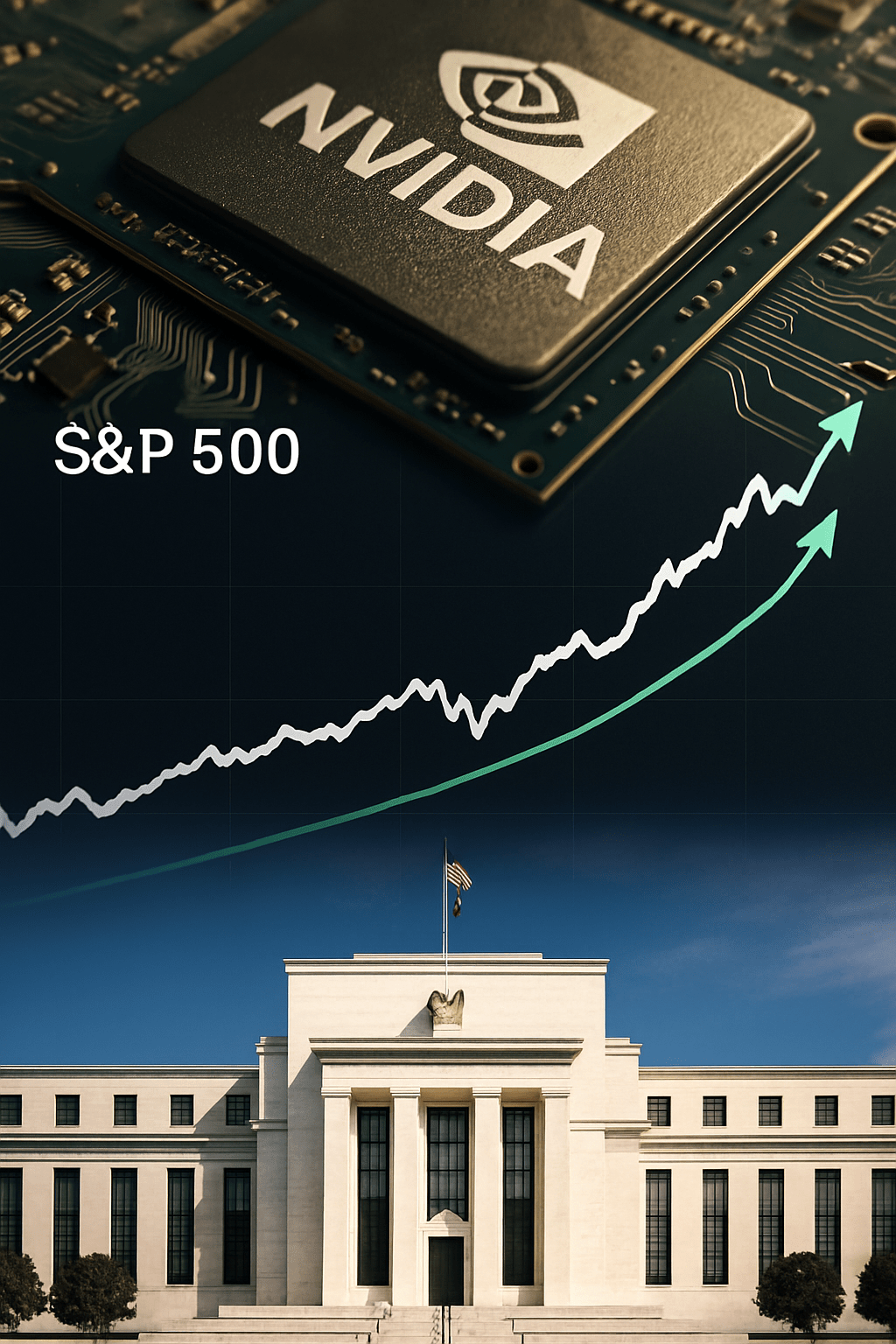
The week of August 25-31, 2025 was marked by Nvidia’s earnings release, which beat expectations with revenue of $46.7 billion (+56% year-over-year), despite halting sales to China. US markets showed remarkable resilience, with the S&P 500 reaching new records at 6,465.94 points. This performance occurred amid stabilizing global monetary policies and growing expectations for Fed rate cuts in September¹. Nvidia
News
1. Nvidia posts record results but refrains from forecasting China sales
The semiconductor giant reported earnings per share of $1.05, beating expectations of $1.01, with quarterly revenue of $46.7 billion. However, the company provided no guidance on H20 chip sales to China for the next quarter, awaiting regulatory clarity on the 15% tax imposed by Washington². Business Insider
Analysis — This caution reflects persistent geopolitical tensions in the technology sector, with Nvidia ready to ship between $2-5 billion in H20 chips depending on government decisions. Kiplinger
In brief — Despite China uncertainty, Nvidia maintains its AI dominance with a gross margin of 72.7%.
2. Federal Reserve holds rates at 4.25-4.50% but signals possible easing
The Fed kept its policy rates unchanged for the fifth consecutive meeting, but two governors voted for a cut, marking the first dual dissent since 1993. Jerome Powell suggested at Jackson Hole that conditions might warrant rate cuts³. Trading Economics
Analysis — Markets now anticipate a 90% chance of a 25 basis point cut in September, supported by signs of labor market weakness and recent political controversy around Fed independence. Reuters
In brief — US monetary policy enters a transition phase toward accommodation.
3. US stock markets reach new heights
The S&P 500 closed at 6,465.94 points (+0.4%), the Nasdaq at 21,544.27 points (+0.4%), and the Dow Jones at 45,418.07 points (+0.3%). Small caps outperformed with the Russell 2000 up 0.8%. This progress came despite political instability and mixed economic data⁴. STL.News
Analysis — Market resilience reflects investor confidence in corporate growth and institutional stability, supported by anticipation of solid technology earnings. Vesta Wealth
In brief — Wall Street demonstrates remarkable ability to overcome political uncertainties.
4. European Central Bank holds rates and ends easing cycle
The ECB kept rates unchanged in July, effectively ending its easing cycle after eight cuts over the past year. The deposit rate remains at 2.0% and the main refinancing rate at 2.15%. Christine Lagarde cited difficulties in assessing US tariff impact⁵. Trading Economics
Analysis — This pause reflects reaching the 2% inflation target in June, but also concerns about trade tensions’ impact on European growth and inflation. ECB
In brief — The ECB adopts a wait-and-see approach amid trade uncertainties.
5. Bank of Japan holds rates at 0.50% but signals future hikes
The BoJ maintained its policy rate at 0.50% at its July meeting, the highest since 2008. Nearly two-thirds of economists anticipate a hike of at least 25 basis points in Q4, possibly in October, despite concerns over US tariffs⁶. Reuters
Analysis — Governor Kazuo Ueda maintains a flexible, data-dependent approach, with inflation exceeding the 2% target for over three years. Equals Money
In brief — Japan prepares to continue gradual monetary normalization.
6. European inflation remains stable at 2.0% in July
Eurozone inflation held at 2.0% year-on-year in July, aligned with the ECB’s target. Services inflation slowed to 3.2% from 3.3% in June, offsetting acceleration in non-energy industrial goods and food prices⁷. Trading Economics
Analysis — This stability around the target comforts the ECB in its monetary pause, though core inflation remains at 2.3%, its lowest since January 2022. Eurostat
In brief — The eurozone shows controlled inflation validating ECB strategy.
7. Chinese manufacturing activity shows mixed signals
China’s official manufacturing PMI stood at 49.4 in August, marking the fifth consecutive month of contraction, while the private PMI jumped to 50.5, its highest since March. This divergence reflects different sectoral dynamics⁸. Macao News
Analysis — The private PMI improvement is partially attributed to export order recovery, highlighting external demand resilience despite tariffs. CNBC
In brief — China navigates between official contraction and private manufacturing recovery.
8. Global bonds under pressure with rising yields
Long-term government bond yields reached their highest levels since 2011 in Germany and France, while Japanese 30-year yields hit new records. This yield rise complicates government financing amid growing borrowing needs⁹. Reuters
Analysis — French political instability and Fed independence concerns contribute to this bond market tension, exacerbated by persistent inflation prospects. LSEG
In brief — Global bond markets face multiple headwinds.
Strategic Outlook
Key upcoming milestones include the Fed’s monetary policy decision on September 17, with high expectations for rate cuts. Investors will also monitor September US employment data and Q3 earnings to assess profit growth sustainability¹⁰. Fortune
The macroeconomic environment suggests a transition toward more accommodative policies in developed economies, but with differentiated paces across regions. Geopolitical and trade tensions remain major risk factors for global financial stability¹¹. Plus500
Good News
The VIX volatility index continued its decline to 15.36 at end-August, signaling the return of calm to markets after early-month turbulence. This volatility easing, combined with accommodative financial conditions, creates a favorable environment for risk assets and continued investment¹². YCharts
Acknowledgements
Thank you for your reading and excellent week.
Go Further
Did you find this brief valuable? To ensure you don’t miss our future analyses and to support our work, please consider:
- Subscribing to our weekly newsletter.
- Following us on LinkedIn for daily insights.
- Sharing this article with your network to enrich the discussion.
Brief’s Glossary
- Artificial Intelligence (AI)¹ : Technologies enabling machines to simulate human intelligence, including machine learning and natural language processing.
- H20 Chips² : Specialized graphics processors developed by Nvidia for the Chinese market, compliant with US export restrictions.
- Jackson Hole Symposium³ : Annual central bankers’ conference in Wyoming, influential forum for monetary policy signals.
- Russell 2000⁴ : US stock index representing small-cap companies, domestic economy barometer.
- Easing Cycle⁵ : Period during which a central bank progressively reduces its policy rates to stimulate the economy.
- Monetary Normalization⁶ : Process of returning interest rates to historically normal levels after accommodation period.
- Core Inflation⁷ : Inflation measure excluding volatile components like energy and food.
- PMI (Purchasing Managers’ Index)⁸ : Economic activity indicator in manufacturing sector, with 50 threshold separating expansion from contraction.
- Bond Yields⁹ : Government bond remuneration rates, key indicator of sovereign financing conditions.
- Earnings Growth¹⁰ : Increase in corporate profits, main driver of stock market performance.
- Accommodative Policies¹¹ : Expansionary monetary measures aimed at stimulating economic growth through low rates.
- VIX Index¹² : Measure of implied volatility in the US market, often called the « fear index ».
 Strat Finance Advisory