
Global Context 🌍
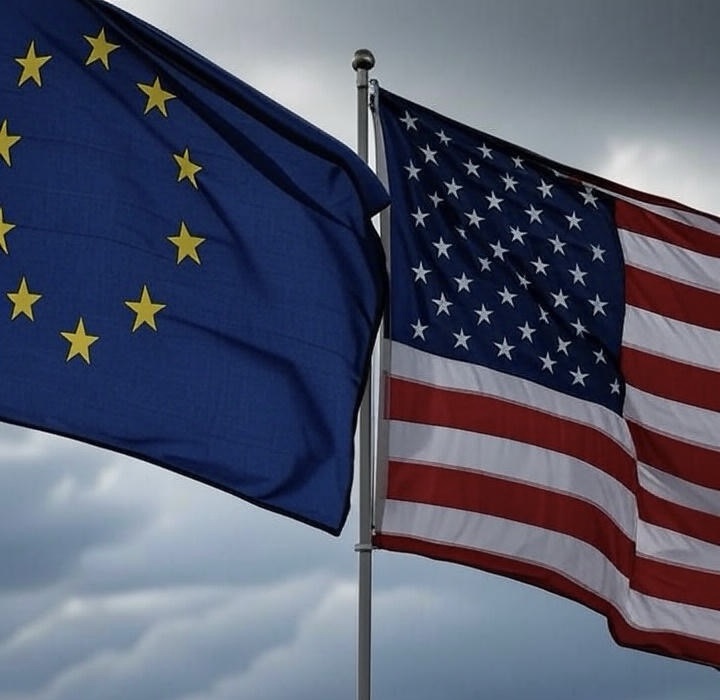
Transatlantic trade relations experienced an exceptional period of tension in 2025, marked by the protectionist offensive of the Trump administration from its return to power in January. This aggressive tariff policy is part of a « rebalancing » strategy for trade exchanges, with the United States reproaching the European Union for a trade surplus of $237 billion in 2024. Negotiations intensified throughout the first half of 2025, alternating between escalation threats and compromise attempts, until reaching a major agreement on July 27, 2025. This context reflects a profound transformation of international economic relations, where commercial multilateralism gives way to assumed protectionism, redefining the geopolitical and economic balance between the two largest commercial powers worldwide. Le Grand Continent
Key Development 📌
On Sunday, July 27, 2025, Donald Trump and Ursula von der Leyen concluded a historic trade agreement in Turnberry, Scotland, narrowly avoiding a major trade war. The agreement provides for the application of 15% tariffs on all European exports to the United States, replacing the initial threat of 30% taxes that was to take effect on August 1st. In return, the European Union committed to purchasing $750 billion worth of American energy over three years and investing an additional $600 billion on American territory. The agreement also provides for the mutual elimination of tariffs on certain strategic products, notably aeronautical equipment, certain chemical products, semiconductor equipment, and critical raw materials. This last-minute negotiation took place in just one hour, after both leaders estimated their chances of success at « 50-50 ». TF1 Info
Updated Analysis 🔎
This agreement marks a decisive turning point in transatlantic trade relations, confirming entry into a new era of uninhibited protectionism. While the agreement avoids immediate escalation toward 30% tariffs, it nevertheless institutionalizes an unprecedented tariff level since the post-war period, as exchanges were previously marked by average American tariffs of 4.8%. The differentiated economic impact by sector reveals winners and losers: the German automotive industry benefits from a relative reduction (from 25% to 15%), while steel and aluminum remain subject to prohibitive 50% duties. The striking asymmetry of the agreement translates into European acceptance of reducing its own tariffs to 0%, illustrating an unfavorable balance of power. Energy purchase commitments de facto replace Russian dependence with American dependence, questioning European energy sovereignty and the achievement of climate objectives. This European capitulation, according to some analysts, reflects internal division between countries favoring appeasement (Germany, Italy) and those advocating firmness (France). BFM TV
Outlook 🚩
The July 27, 2025 agreement constitutes more of a temporary armistice than a definitive solution to transatlantic trade tensions. The necessary validation by the 27 EU member states could reveal internal dissensions, particularly French ones, faced with what is perceived as economic « vassalization ». In the short term, the impact on European growth should remain moderate (estimated decline between 0.1% and 0.3% of GDP according to CEPII), but certain sectors such as aeronautics and French shipbuilding risk being particularly affected. The energy purchase commitment of $750 billion over three years structurally transforms European energy geopolitics, reinforcing transatlantic dependence at the expense of supply diversification. In the medium term, this tariff precedent could encourage other commercial powers to adopt similar strategies, accelerating global trade fragmentation. The European Union will now have to rethink its commercial strategy, between seeking alternative free trade agreements with Asia and strengthening its strategic autonomy, in a context where commercial multilateralism seems definitively over. L’Express
 Strat Finance Advisory